Buddhism

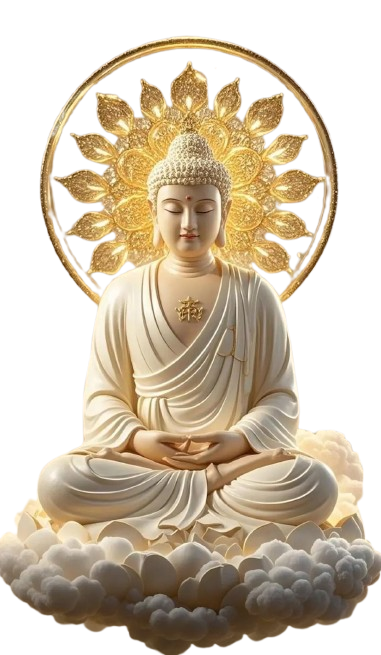
Statue of a meditating person wearing prayer beads, sitting in a lotus position among lush green foliage and lotus plants.

Buddhism is the spiritual foundation of Shaolin Kung Fu. In alignment with Zen (Chan) philosophy, the monks of the Shaolin Temple view martial practice as a form of meditation in motion — a way to cultivate discipline, mindfulness, and harmony between body and mind. The physical routines strengthen them for long hours of seated meditation, while the ethical teachings of Buddhism ensure that martial skills are guided by compassion and self‑restraint rather than aggression.

Zen Buddhism emphasizes direct experience, meditation, and living in the present moment. There is a heavy focus on mindfulness and cultivating awareness and insight through meditative practices. This integration of spiritual cultivation with martial discipline gives Shaolin Kung Fu its unique identity: a tradition where every strike, stance, and breath reflects the Buddhist pursuit of balance, inner peace, and enlightenment.

Origins of Buddhism

The philosophies of Buddhism first arose in India over 2500 years ago. Siddharta Guatama - the Buddha - started life as a prince with every luxury at his command. Before his birth, his mother Queen Maya had a prophetic dream in which a white elephant carrying a lotus flower descended from the heavens and entered her right side. This vision was interpreted as a divine sign that she would give birth to a child destined to become either a great world ruler or a fully enlightened spiritual leader. The Buddha’s father, King Suddhodana, desperate for his son to become the great world ruler that would succeed him, sheltered young Siddhata in the palace throughout his early years, away from the hardships of the outside world.

Siddhata grew curious of the world outside the walls, and on his 16th birthday requested a tour of the kingdom. The king did his best to curate the experience, ordering the town to be cleansed thoroughly before the event. Despite the Kings effort to shield the Prince from such hardships faced by everyday people, Siddhata was confronted by the realities of aging, sickness and death. He began pondering the suffering of mankind, and was determined to find a solution. At the age of 29, he left his kingdom and became an ascetic in search of this solution.

For six years the ascetic Gautama wandered about the valley of the Ganges, meeting famous religious teachers and studying their systems and methods, submitting himself to rigorous practices. They did not satisfy him. He then abandoned all traditional religions and their methods, setting upon his own path to enlightenment. At the age of 35, Siddhata Gautama sat underneath the Bodhi Tree, with the vow to not rise until he had realized the truth that ends suffering. He sat for 49 days, and then rose as Buddha - The Enlightened One.

Soon after, the Buddha was compelled to teach what he had learned about the nature, rise and cessation of suffering. In the Deer Park at Isipatana (modern Sarnath), the Buddha gave his first sermon to a group of five ascetics. From that day on, for 45 years he taught all classes of men and women, kings and peasants, bankers and beggars, holy men and robbers - without making the slightest distinction between them. He preached to all who were ready to understand and follow, giving rise to the spiritual movement we understand today as Buddhism.

The Four Noble Truths

The Buddha’s message to the world is centred around the four noble truths. These Noble Truths can be summarised as:

The First Noble Truth: Dukkha

The Second Noble Truth: Samudaya: The Arising of Dukkha

The Third Noble Truth: Nirodha: The Cessation of Dukkha

The Fouth Noble Truth: Magga: The Eightfold Noble Path - the way leading to the cessation of Dukkha

Dukkha is a word without a direct English translation, as such it is commonly misinterpreted as simply ‘suffering’. While the intention of the word Dukkha does encapsulate suffering, it also includes deeper ideas such as; impermanence, imperfection, emptiness and insubstantiality. The understanding of Dukkha leads to a life of balance, hence why the Eightfold path is often referred to as The Middle Way. When standing in the middle you are optimally placed to see the full spectrum as it unfolds, a proverbial vantage point which allows you to see the world objectively.

In the text What the Buddha Taught, Walpola Rahula explains that one physician may gravely exaggerate an illness and give up hope altogether. Another may wishfully and ignorantly declare there is no illness and that no treatment is necessary, thus deceiving the patient with a false consolation. You may call the first one pessimistic and the second optimistic. Both are equally dangerous. A third physician diagnoses the symptoms correctly, understands the cause and nature of the illness, sees clearly that it can be cured, and administers a course of treatment, thus saving the patient. The Buddha is like the last physician.

In practice, Buddhism is a philosophy that allows a person to develop into the most free and capable version of themselves. The wisdom of the doctrine is much deeper than can be explained in a few paragraphs, but practicing well feels like living life with the full range of human emotion and experiences, but without the attachments and clinging that will inevitably lead to suffering.

A purple water lily blooming in a pond surrounded by green lily pads.
  1. Right Understanding

  2. Right Thought

  3. Right Speech

  4. Right Action

  5. Right Livelihood

  6. Right Effort

  7. Right Mindfulness

  8. Right Concentration

The Eightfold Noble Path